Why Trusq runs on EU infrastructure
Trusq is a customer support platform for small and mid-sized companies in Germany, and from the first line of the product requirements we wrote one rule that has shaped almost every technical decision since: no US sub-processors in the core data pipeline. Every ticket, every customer message and every answer our AI drafts is processed by companies that are not subject to US law.
That sounds like a marketing line, so it is worth explaining why it is an engineering constraint, what we chose because of it, and what it costs us.
Why data residency is not enough
The large US cloud providers all offer EU regions, and the data in them does stay in Frankfurt or Dublin. What matters is who owns the company that runs the machines. US law, in particular the CLOUD Act and Section 702 of FISA, can oblige a US-headquartered provider to hand over data it controls, wherever that data is stored. Since the European Court of Justice struck down the Privacy Shield in the Schrems II ruling, every transfer of personal data into that reach has to be justified and assessed.
For many of our customers this is not theoretical. Tax advisers and law firms, whom we increasingly serve, are bound by professional secrecy, and they want to know where their clients' data goes and who could be compelled to hand it over. We decided we would rather answer that question with a short list of European companies than with a stack of transfer impact assessments.
What we chose
We compared four providers for the infrastructure: Hetzner, OVHcloud, IONOS and the EU region of AWS. We chose Hetzner. It is a German company with no US parent, its data centres are in Falkenstein, Nuremberg and Helsinki, and its prices are far below the hyperscalers', which matters for a young company. "Hosted on Hetzner in Germany" also turned out to be a sentence our customers recognise and trust. OVHcloud stays our documented fallback.
On top of that we run Kubernetes ourselves, with k3s, provisioned with OpenTofu. Files go to Hetzner's object storage, which needs no transfer impact assessment because the provider is a German legal entity. For the AI that drafts answers we use Mistral, a French company: when we evaluated the market in March 2026, we found no credible alternative among EU-incorporated providers that offered a production API.
Wherever a service would have added a foreign party to the data path, we preferred to run it ourselves. Our outgoing email now leaves through our own mail server instead of a sending service, billing runs on a self-hosted system, and so do search and error tracking. Each of these removed one company from the list of parties that touch our customers' data.
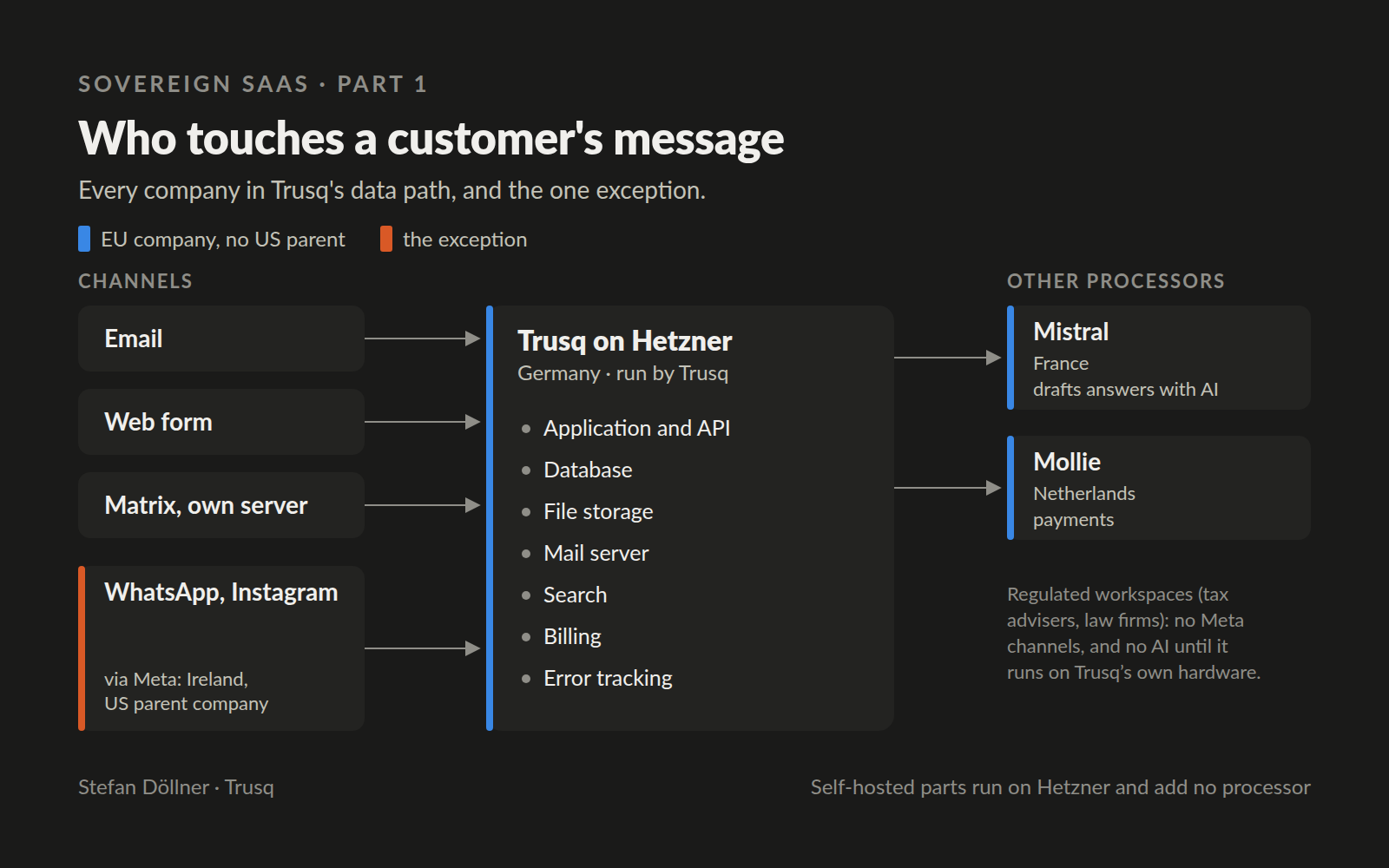
Every company in the data path, and the one exception.
What it costs
The decision is not free, and we wrote the costs down when we made it. Hetzner's managed services are less mature than those of AWS or Azure, so we operate more ourselves: the Kubernetes cluster, the database, the message queue, the mail server. That is more work for a small team, and it is work we have to be good at. Hetzner's two German locations are not far apart, so real geographic redundancy means Helsinki or a second provider. And some enterprise buyers still ask why we are not on AWS; our answer is the same one this article gives.
The AI side has its own price. A hosted model from an EU company is a smaller market than the US offerings, and for customers bound by professional secrecy we go further and keep AI on infrastructure we operate ourselves. Where that is not available yet, those workspaces get no AI rather than a fallback to a hosted model. That is a deliberate choice, and it deserves its own article.
The one exception
There is one place where the rule bends, and we would rather say so than have someone find it. Many of our customers' own customers write to them on WhatsApp or Instagram, and both mean Meta. We treat Meta as the single authorised exception: it is documented with a transfer impact assessment, covered by the EU standard contractual clauses and the EU-US Data Privacy Framework, uses WhatsApp's EU data storage, and is reviewed again whenever its legal basis changes. These are channels each customer connects for themselves, and our plan for regulated professions does not offer them at all.
What carries over
A constraint like this is easiest to keep when it is written down as a rule at the start, with its reasons, so that every later decision can be checked against it instead of being argued from scratch. Ours has removed options, added operational work and occasionally lost a conversation with a buyer who wanted a familiar name. It has also given us a product whose data path we can explain on one page.